
Gutter Cleaning in Bergen County, NJ
Hand-cleaning of gutters and downspouts, flush-testing every outlet, and a check of hangers, seams and pitch while we are up there.
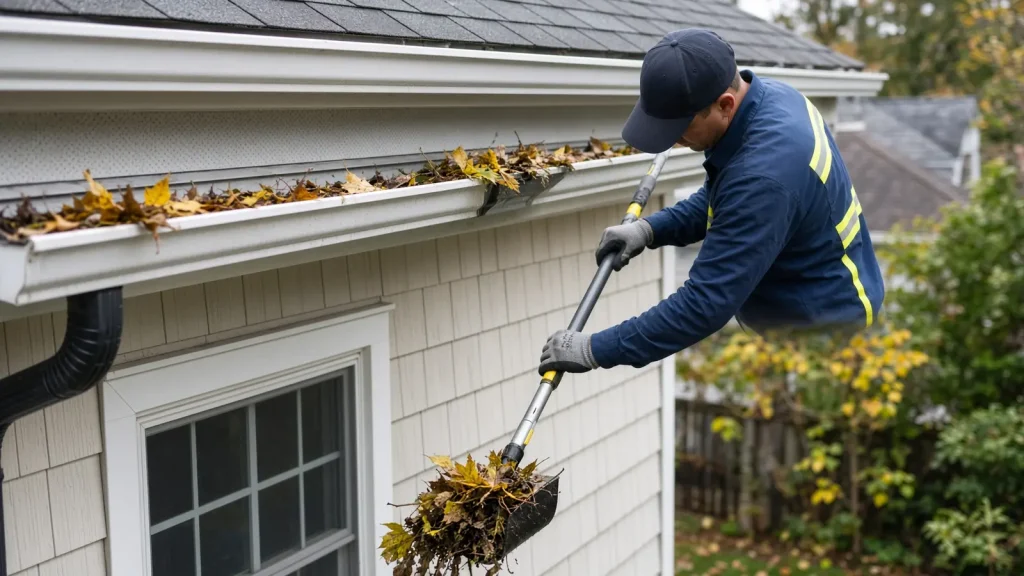
We bag debris rather than blow it into the beds, then flush each run to confirm the downspouts actually drain. Anything loose or leaking gets flagged with a photo.
This is one part of the gutters work we do across Bergen and Passaic County. Every job is quoted in writing after a hands-on inspection, performed by our own crew rather than subcontractors, and backed by our satisfaction guarantee. We are licensed under NJ HIC #13VH13359900 and fully insured.
What the work includes
- Hand clearing of trough and downspouts
- Flush test of every outlet and underground tie-in
- Hanger, seam and pitch inspection
- Debris removed from the property
How often do gutters need cleaning under mature trees?
Under heavy tree cover, gutters generally need cleaning twice a year, in late fall after leaf drop and again in spring once seed pods and winter debris have settled. Homes with little or no overhanging canopy can often stretch to once a year, but any roof should get an extra check after a storm that drops branches or an unusual amount of debris.
Twice a year is a starting point, not a fixed rule. A single mature oak overhanging one corner of a roof can fill that section faster than a whole property with distant trees. We size the schedule to what is actually over the roof, not to a calendar interval that ignores the specific trees on the lot.
- Heavy canopy on most of the roof — plan on two visits a year, late fall and spring
- Partial or distant tree cover — often one visit a year is enough, timed to fall
- Pine-heavy lots — needles drop over a longer season than broad leaves and clog faster in smaller volumes, so these roofs sometimes need a third check mid-season
- After any major storm — an extra look regardless of the regular schedule, since storm debris does not wait for the next planned visit
Homes with gutter guards or gutter screens already installed can usually stretch these intervals, but neither system eliminates the need for an occasional check.
Why fall and spring are the two cleanings that matter most
A fall cleaning matters because gutters need to be clear before the first hard freeze, so meltwater has somewhere to go instead of building ice in a debris-packed trough. A spring cleaning matters because winter leaves behind grit, seed pods and anything that blew in during storms, and a gutter entering the heavy spring rain season already full has no capacity left when it is needed most.
These two windows are not arbitrary. Building America guidance on cold-climate maintenance is direct: gutters should be clean heading into winter, or fitted with leaf screens, specifically so they drain instead of filling with water that then freezes. A gutter packed with wet leaves in December is not just clogged — it is a mold for ice that adds weight and can pull hangers loose before the season is over.
Spring cleaning matters for a different reason. New Jersey’s heaviest short-duration rain often arrives from spring storms and, later, from the remnants of tropical systems, and a trough still half-full of winter debris has far less volume before it overflows. Clearing it before that season starts restores the full capacity the gutter was sized for. Between these two visits, a summer check is optional on most properties, but recommended where thunderstorms regularly drop small branches — a pattern we see regularly on the tree-lined streets around Glen Rock and Wayne.
What do the warning signs of an overflowing gutter look like?
Overflowing gutters show up as water sheeting off the front edge during rain instead of draining through downspouts, erosion trenches or mulch washouts directly under a run, staining or streaking on siding below the gutter line, and a trough that is visibly sagging or still holding water a day after the last rain. Any one of these is worth a look before it becomes a repair.
Most of these signs are visible from the ground without a ladder, which is why we recommend homeowners do a quick visual check after a hard rain rather than waiting for the scheduled cleaning date.
What to look for
- A curtain of water coming off the front edge of the gutter during a storm, rather than through the downspout
- A groove or bare patch in the mulch or lawn directly below a run — a sign water has been overflowing there repeatedly, not just once
- Dark streaks or a chalky white residue on siding or masonry under the gutter line
- Standing water still visible in the trough the day after rain has stopped, which usually means either a clog or a pitch problem
Streaking or erosion at the same spot every storm points to a clog worth clearing before it becomes a bigger problem. If the trough itself looks intact but the water still overflows, that is more often a gutter repair issue — sizing, pitch or a hanger problem — than something a cleaning alone will fix. Our article on signs of improper gutter installation in Passaic County covers how to tell the two apart.
What ladder safety rules matter for a DIY gutter cleaning?
The U.S. Consumer Product Safety Commission recommends setting a straight or extension ladder at roughly a 75-degree angle, extending it at least 3 feet above the roofline, checking its load rating before climbing, keeping the body centered between the rails, and never standing on the top three rungs. Gutter cleaning is one of the more common reasons a homeowner ends up on a ladder at home.
Gutter cleaning looks like a simple chore, which is exactly why ladder injuries connected to it are so common. The Consumer Product Safety Commission’s own ladder safety guidance lays out specifics worth following if you are doing the work yourself:
- Set the base so the ladder sits at about a 75-degree angle — test this by standing with your toes at the base and extending your arms; your palms should just reach the rung at shoulder height
- Confirm the ladder’s load rating covers your weight plus anything you are carrying, such as a bucket of wet debris
- Use a ladder with slip-resistant feet on both straight and adjustable models
- Only one person on the ladder at a time, with your body centered between the rails rather than leaning to reach a section
- Never stand on the top three rungs of a straight, single or extension ladder
- Extend the ladder at least 3 feet above the roofline or gutter edge before climbing onto or working near the roof
The National Institute for Occupational Safety and Health publishes a similar angle guideline and an inspection checklist worth running through before every climb, not just the first one of the season. For a two-story home, steep roof, or any run over a driveway or hardscape, the fall risk from a mistake is high enough that most homeowners are better served calling for a professional visit than working it out on a ladder alone.
What a professional gutter cleaning from NJ Gold Star includes
A professional gutter cleaning from NJ Gold Star Construction is a hand-cleared trough and downspout, a flush test of every outlet to confirm it actually drains, and a visual check of hangers, seams and pitch while the crew is already up there. Debris is bagged and hauled off the property rather than blown into garden beds.
We treat cleaning as an inspection opportunity, not just a chore to check off. Catching a loose hanger or a cracked seam during a routine cleaning is far cheaper than finding it after a storm has already done damage. Homeowners can request a cleaning on the same visit as any other gutter work through our contact page.
Hand-clear the trough
Debris is removed by hand and bagged, not blown into beds or left on the lawn, section by section along every run on the property.
Flush every outlet
Water is run through each downspout to confirm it drains freely, including any underground tie-in, rather than assuming a clear trough means a clear downspout.
Check hangers, seams and pitch
While the trough is clear and visible, we look for loose hangers, failed seam sealant, and any section holding water that points to a pitch problem.
Flag anything that needs repair
Soft fascia, a sagging run, or a downspout that will not flush gets photographed and noted, with a written repair option offered rather than a surprise on a future invoice.
Haul debris off the property
Bagged leaves, needles and grit leave with the crew rather than becoming mulch-bed cleanup for the homeowner.
Related gutters services
Seamless aluminum, copper or vinyl gutters formed on site, sized and pitched to the roof area th…
Gutter guard installation matched to your debris load, from micro-mesh for pine needles and shin…
Simple, cost-effective gutter screens that keep leaves and twigs out of the trough while staying…
Repair of sagging, leaking or overflowing gutters — reseating hangers, resealing seams and end c…
Gutter Cleaning service areas
We provide gutter cleaning from our Totowa base across these towns. Each link opens that town’s page, with local permit and building notes.
Bergen County: Allendale · Bergenfield · Cliffside Park · Demarest · Elmwood Park · Emerson · Englewood · Fair Lawn · Fairview · Fort Lee · Franklin Lakes · Garfield · Glen Rock · Hackensack · Harrington Park · Hasbrouck Heights · Hillsdale · Lodi · Mahwah · Montvale · Old Tappan · Oradell · Palisades Park · Paramus · Park Ridge · Ramsey · Ridgefield Park · Ridgewood · Rochelle Park · Rutherford · Teaneck · Tenafly · Waldwick · Westwood · Woodcliff Lake · Wyckoff
Passaic County: Clifton · Haledon · Hawthorne · Little Falls · Paterson · Totowa · Wayne · West Milford
Essex County: Montclair · Nutley · Verona
Hudson County: Jersey City · Secaucus
Morris County: Morristown · Parsippany
Union County: Summit
Rockland County, NY: Suffern, NY
Not listed? Call (862) 271-1225 and ask whether we cover your address.
Where we work: from our Totowa base across North Jersey
Frequently asked questions
How often do gutters need cleaning?
Twice a year under trees, once a year otherwise, plus a check after heavy leaf drop or a storm.
Can clogged gutters cause a roof leak?
Yes. Standing water backs up under the shingle edge and, in winter, forms the ice dams that push water into the house.
How does downspout flushing work and why does it matter?
We run water into the top of each downspout and confirm it exits freely at the bottom or underground outlet. A trough that looks clear can still have a clogged elbow or a crushed underground line, and flushing is the only reliable way to catch that — a visual check of the open gutter alone will miss it.
Is it worth hiring a professional instead of cleaning gutters myself?
For a single-story home with easy ground access, a careful DIY cleaning following standard ladder safety guidance can be reasonable. For a two-story home, a steep roof, or a run over a driveway or patio, the fall risk usually outweighs the cost of a professional visit, which also adds a hanger, seam and pitch check that a quick DIY pass typically skips.
What is the best weather for a gutter cleaning appointment?
Dry, calm days are easiest and safest for ladder work. We avoid scheduling cleanings during or right after heavy rain, when troughs are running full and footing near downspouts can be slick, and during high wind, when a loaded ladder becomes harder to keep steady.
Does a gutter cleaning include checking the roof itself?
A cleaning includes a visual check of the gutter, fascia, hangers and seams, not a full roof inspection. If anything visible from the gutter line — lifted shingles, damaged flashing, granule loss — looks like it needs a closer look, we note it and can schedule a separate roof inspection through our roofing services.
- Gutters and Downspouts — U.S. Department of Energy, Building America Solution Center (PNNL)
- A Brief Guide to Mold, Moisture and Your Home — U.S. Environmental Protection Agency
- Ladder Safety 101 — U.S. Consumer Product Safety Commission, OnSafety blog
- Ladder Safety App — Centers for Disease Control and Prevention, National Institute for Occupational Safety and Health (NIOSH)
Updated September 2026 · Reviewed by Edgar Lopez Gonzalez, owner · NJ HIC #13VH13359900
Licensed & insured. 25+ years in North Jersey. We answer 24/7 for leaks and storm damage.
- Service
- Gutter Cleaning
- Category
- Gutters
- Service area
- Bergen & Passaic County and surrounding North Jersey
- License
- NJ HIC #13VH13359900