
Home › Areas We Serve › Passaic County
Roofing, Chimney, Masonry & Exterior Contractor in Passaic County, NJ
NJ Gold Star Construction is based in Totowa, in Passaic County, and serves the county with roofing, chimney work, masonry steps and stone walls, poured concrete sidewalks, gutters, siding and decks. We are licensed (NJ HIC #13VH13359900), insured, give free written estimates and answer emergency leak calls 24/7.
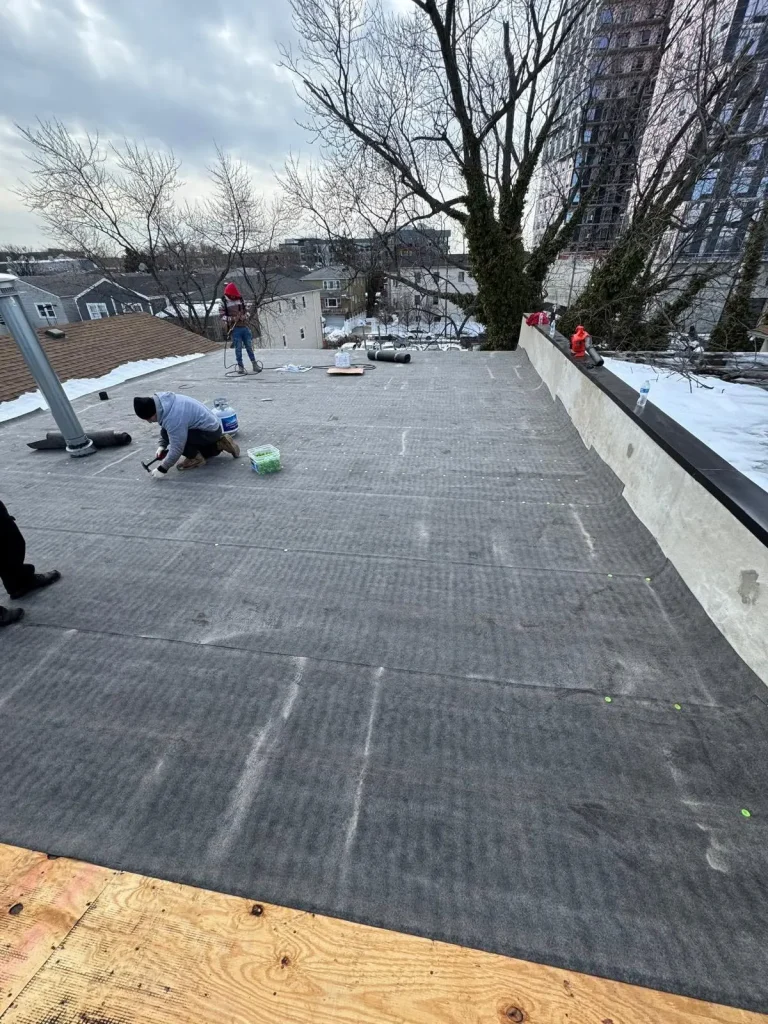
Passaic County is our home county: the shop is in Totowa, and Paterson, Clifton, Wayne, Hawthorne, Little Falls, Haledon and West Milford are all on our service map. Each town runs its own permit office, and the rules differ more than most homeowners expect.
The pages below cover how permits work town by town, what the Passaic River and the county’s older housing do to exteriors, and how to choose a contractor.
What exterior work does NJ Gold Star do across Passaic County?
NJ Gold Star Construction is based in Totowa, in Passaic County, and handles roofing, chimney repair and rebuilds, masonry steps and stone walls, poured concrete sidewalks, seamless gutters, siding and decks across the county. It is our home county, so it is where emergency leak calls are easiest to reach quickly, though we promise no response time.
Passaic County is where the shop is. From Totowa we serve towns on both sides of the Passaic River, and the work ranges from a single flashing repair to a full tear-off, a chimney rebuild or a new deck. The services are the same everywhere we work; what changes from town to town is the paperwork and the conditions.
- roofing services: repair, replacement, attic ventilation and roof maintenance.
- chimney services: chimney repair, chimney liner installation, chimney caps and chimney rebuilds.
- masonry services: masonry steps, poured concrete sidewalks, natural stone walls and foundation repair.
- gutter services: seamless installation, guards, screens and cleaning.
- siding and deck building.
We are licensed as a New Jersey home improvement contractor (HIC #13VH13359900), fully insured, and we use our own crew. We answer 24/7 for active leaks and storm damage and reach them the same day whenever possible. We do not promise a response time, because storms do not run on a schedule.
One county, eight rulebooks: how permits differ across Passaic County towns
Passaic County has no single permit office. Each municipality enforces the state Uniform Construction Code through its own office, and the roofing lines differ: Haledon allows like-material roof repairs up to 25% of the roof in a year without a permit, West Milford exempts roofs on detached one- and two-family homes, and Little Falls routes floodplain questions through zoning.
| Town | A rule or process worth knowing | Our page |
|---|---|---|
| Haledon | Like-material roof repair up to 25% of the roof in a year needs no permit; new siding needs one; no permits issued after 4:00 p.m. | Haledon |
| West Milford | No roof permit on a detached one- or two-family home; other buildings need one; weekend construction 9 a.m. to 6 p.m. | West Milford |
| Little Falls | Floodplain regulations run through the zoning contact; inspections scheduled through the township portal | Little Falls |
| Wayne | Permits and Inspections office with an online self-service portal | Wayne |
| Hawthorne | Building Department sets hours and a permit-issuance cutoff | Hawthorne |
| Clifton | Building office posts the F100 permit application and subcode forms | Clifton |
| Paterson and Totowa | We could not read a local permit page for either, so we call before quoting | Paterson · Totowa |
The State sets the framework: the Uniform Construction Code is Chapter 23 of Title 5 of the New Jersey Administrative Code, with subchapters for administration and for local enforcing agencies. Each town then runs its own office and publishes its own guidance. These are the rules we have read from the towns’ own pages.
The Passaic River: a 762-square-mile watershed behind every county foundation question
The U.S. Geological Survey’s Passaic River gauge at Little Falls measures a drainage area of 762 square miles, with daily records back to 1897. FEMA’s Map Service Center is the official source for flood hazard maps. Before foundation, wall or grading work in a river county, check the map and ask the town.
Passaic County is named for a river, and the river’s watershed is large. The USGS monitoring location Passaic River at Little Falls NJ, operated with the New Jersey Department of Environmental Protection, the Passaic Valley Water Commission and the Army Corps of Engineers, records a drainage area of 762 square miles. Its daily record begins in 1897.
A gauge says nothing about your lot. What it says is that the river collects water from a very large area, and a county built along it should treat drainage as part of nearly every exterior project. FEMA describes a 1% annual-chance flood area as high risk, with at least a one-in-four chance of flooding over a 30-year mortgage, and points to its Map Service Center as the official source for the maps.
What this changes in our work
- We look at gutter capacity, downspout discharge and grade as one system. See gutter services.
- We ask about floodplain status before foundation, masonry or grading work. See foundation repair.
- We never promise that a repair will keep water out of a basement that has a groundwater problem; we find the source first.
Paterson's Great Falls and the county's older building stock
The National Park Service describes the Great Falls of the Passaic River as central to Paterson’s development as an industrial city. Dense, older buildings are a feature of that history, and they bring their own exterior problems: flat and low-slope roofs, aging chimneys, and brick that has seen many freeze-thaw winters. We inspect before we recommend.
Paterson’s Great Falls National Historical Park tells the story of a waterfall that powered an industrial city. We do not draw conclusions about any particular building from that history. What we can say from the work is that older masonry buildings, wherever they stand, share a set of problems that are worth looking for.
- Low-slope and flat roofs that need membrane inspection at seams, drains and edges.
- Chimneys with failing crowns, open mortar joints or unlined flues.
- Brick and mortar where repairs have to match the existing material rather than overpower it.
- Gutters and downspouts that were once steel or integral and are now failing.
Our Paterson page covers the local picture, and the chimney services and roofing services pages explain the work. The Chimney Safety Institute of America cites NFPA 211, which calls for chimneys, fireplaces and vents to be inspected at least once a year.
Snow, freeze-thaw and the calendar for Passaic County exteriors
The New Jersey State Climatologist reports that northern New Jersey averages 40 to 50 inches of snow a year, with an average last spring frost of May 4 and first fall frost around October 7 in the Northern Zone. Masonry and concrete work best between those dates, roofing and siding run in a wider window, and gutters belong after leaf drop.
The climate figures are zone averages, not a Passaic County record, so treat them as a planning guide. They still explain why exteriors here wear the way they do: repeated freezing and thawing works water into every small gap, and snow loads and ice at the eaves test roofs every winter.
A working calendar
- Spring (after the last frost): masonry steps, concrete walks, stone walls and patios.
- Summer: roof replacement and siding, when materials are easiest to handle.
- Early fall (before the first frost): the last window for concrete and mortar, and a good time for chimney work before the heating season.
- Late fall: gutter cleaning after the leaves drop, and a roof check before snow.
- Winter: emergency repairs only; we tarp, then schedule the permanent work.
The Insurance Institute for Business & Home Safety explains why ice dams form and what reduces them: attic ventilation, insulation and sealed ceiling openings. Our attic ventilation and maintenance pages cover the attic side.
Where permit logistics catch Passaic County homeowners out
Three small rules cause the most trouble in Passaic County: Haledon issues no permits after 4:00 p.m. and fines a hidden permit placard $250, Little Falls closes its permit counter earlier than its office, and West Milford says it cannot guarantee an inspection time. We plan permit visits for the morning and keep work visible until it has been inspected.
None of these is dramatic. All of them have delayed projects.
- Haledon: the office is open until 4:30 p.m., but no permits are issued after 4:00 p.m., and the permit placard must be visible from the street at all times, with a $250 fine if it is not.
- Little Falls: counter hours end at 3:30 p.m. Monday to Thursday and 12:30 p.m. Friday, with last full-service admission at 3:15 p.m. and 12:15 p.m.
- West Milford: inspection windows are posted by trade, but the township says it cannot guarantee a specific time.
We handle these as a matter of routine: permits are picked up in the morning, the placard goes up on day one, and every inspection stage stays uncovered until it has been seen. Our pages for Haledon, Little Falls and West Milford have the details, and our estimate form is the place to start.
How do you choose a contractor in Passaic County?
Check the home improvement registration on the state’s license verification system, ask who pulls the permit and requests the inspections, get a written itemized scope, and tie the final payment to a passed final inspection. Compare estimates on what they include, not only on price, and be wary of anyone who says a permit is never needed.
Prices vary, and so do what they leave out. A short list of checks does most of the work.
- Registration. Look up the contractor on the Division of Consumer Affairs license verification system. Ours is NJ HIC #13VH13359900.
- Permit and inspections. Ask who files the permit, who requests the inspections and whether the fee is in the price.
- Written scope. Materials, areas, tear-off, underlayment, flashing, cleanup and what happens if hidden damage turns up.
- Payment. Several Passaic County towns’ pages say final payment should wait for the final inspection.
- Record. Dated photos before surfaces are covered, plus the permit and sign-offs.
Our project gallery shows finished work, and each service page lists what is included.
What happens when a roof leaks or a storm hits in Passaic County?
Call us at any hour. We answer 24/7 and reach active leaks the same day whenever possible, tarping the damaged area to stop water. After that we inspect the roof hands-on and write a scope for the permanent repair, with any permit the town requires. We promise no specific arrival time.
A leak is a sequence, and the first steps are about containing it.
Contain
Move belongings, set out buckets, and shut off power to any room where water is coming through a ceiling fixture.
Document
Take dated photos and video inside and out. They are the start of any insurance claim.
Call
We answer 24/7 and reach active leaks the same day whenever possible.
Tarp
We cover the damaged area to stop water. This is temporary.
Scope and repair
We inspect hands-on, write the permanent scope, check whether the town needs a permit and schedule the work.
Which Passaic County town page covers my area?
We have pages for Paterson, Clifton, Totowa, Wayne, Hawthorne, Little Falls, Haledon and West Milford. Each covers that town’s permit office, local conditions and the services we provide there. If your town is not listed, we likely still serve it; call and ask.
Pick the page closest to your address:
- Totowa: our home borough.
- Paterson and Clifton: the county’s two largest cities.
- Wayne, Hawthorne and Little Falls: river towns along the Passaic.
- Haledon: the borough of the Botto House.
- West Milford: the county’s northern township.
Passaic County borders Bergen County, where most of our pages are, and our Bergen County page covers those towns. For the full list, see all service areas.
Exterior services in Passaic County
Roof repair, full replacement, attic ventilation and maintenance, with 24/7 emergency leak response.…
Repairs, rebuilds, stainless liners, caps, chase covers and deep cleaning.…
Masonry steps, poured concrete sidewalks, natural stone walls, stone veneer and foundation repair.…
Seamless gutters, guards, screens, repairs and cleaning.…
Vinyl and fiber cement siding, installed and repaired with the flashing behind it done right.…
New decks and structural repair, built to code on proper footings.…
Passaic County service area map
Request a free estimate
Tell us about the project and we will call or text you back. For an active leak call (862) 271-1225 now.
Frequently asked questions
Is NJ Gold Star Construction based in Passaic County?
Yes. Our shop is in Totowa, in Passaic County. We also work in Bergen, Essex, Morris and other counties. We answer 24/7 and reach active leaks the same day whenever possible, but we do not promise a response time.
Do I need a permit for a roof in Passaic County?
It depends on the town. Haledon allows like-material repairs up to 25% of the roof in a year without one, West Milford exempts roofs on detached one- and two-family homes, and other towns decide case by case. We confirm with the town before we quote.
Is my Passaic County house in a flood zone?
We do not issue flood determinations. Check FEMA’s Map Service Center and ask your town, since floodplain rules differ. Little Falls, for example, handles floodplain regulations through its zoning contact. We ask before any foundation, wall or grading work.
What is the best time of year for masonry in northern New Jersey?
Between the last spring frost and the first fall frost, which the State Climatologist averages at about May 4 and October 7 for the Northern Zone. Mortar and concrete need to cure above freezing. Roofing and siding run in a wider window.
Do you handle chimney work in Paterson and the older Passaic County towns?
Yes. We repair, reline and rebuild masonry chimneys and clean flues, starting with an inspection. The Chimney Safety Institute says NFPA 211 calls for chimneys to be inspected at least once a year, and we give a written scope before any work.
How do I check a Passaic County contractor?
Use the state’s license verification system to confirm the home improvement registration, ask who files the permit and requests inspections, get a written scope, and hold the last payment until the final inspection passes. Ours is NJ HIC #13VH13359900.
- Passaic River at Little Falls NJ (USGS 01389500) — U.S. Geological Survey
- Flood Maps — Federal Emergency Management Agency (FEMA)
- Overview of the Climate of New Jersey — Office of the New Jersey State Climatologist, Rutgers University
- Paterson Great Falls National Historical Park — U.S. National Park Service
- Building Department — Township of Little Falls, NJ
- Building-Construction/Code Department — Borough of Haledon, NJ
- Building Department FAQ — Township of West Milford, NJ
- Permits and Inspections — Wayne Township, NJ
- Building Dept./Construction Inspection — Borough of Hawthorne, NJ
- Applications & Forms — Building — City of Clifton, NJ
- Homeowner Resources — Chimney Safety Institute of America
- Ice Dams: Prevent Them and Your Roof Will Thank You — Insurance Institute for Business & Home Safety
- License Verification System — NJ Division of Consumer Affairs
- The Uniform Construction Code (NJAC 5:23) — New Jersey Department of Community Affairs, Division of Codes and Standards
Updated October 2026 · Reviewed by Edgar Lopez Gonzalez, owner · NJ HIC #13VH13359900
Licensed & insured. 25+ years in North Jersey. We answer 24/7 for leaks and storm damage.
- County
- Passaic County, NJ
- License
- NJ HIC #13VH13359900
- Emergency service
- 24/7 — call (862) 271-1225
- Estimates
- Free, written and itemized