
Masonry Contractors in Bergen County, NJ — Steps, Patios & Walls
We build and repair steps, walkways, patios, sidewalks, retaining walls and stone veneer across Bergen and Passaic County. Every job is built on a compacted base with drainage designed in, which is what separates masonry that lasts twenty years from work that heaves in the first hard winter.
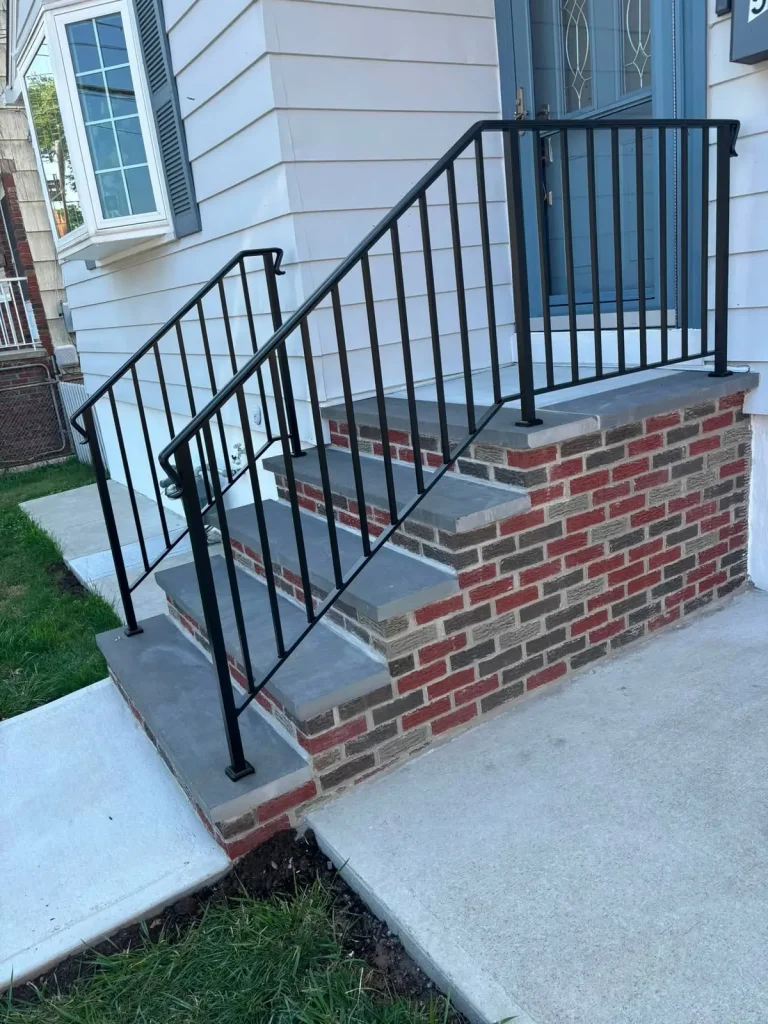
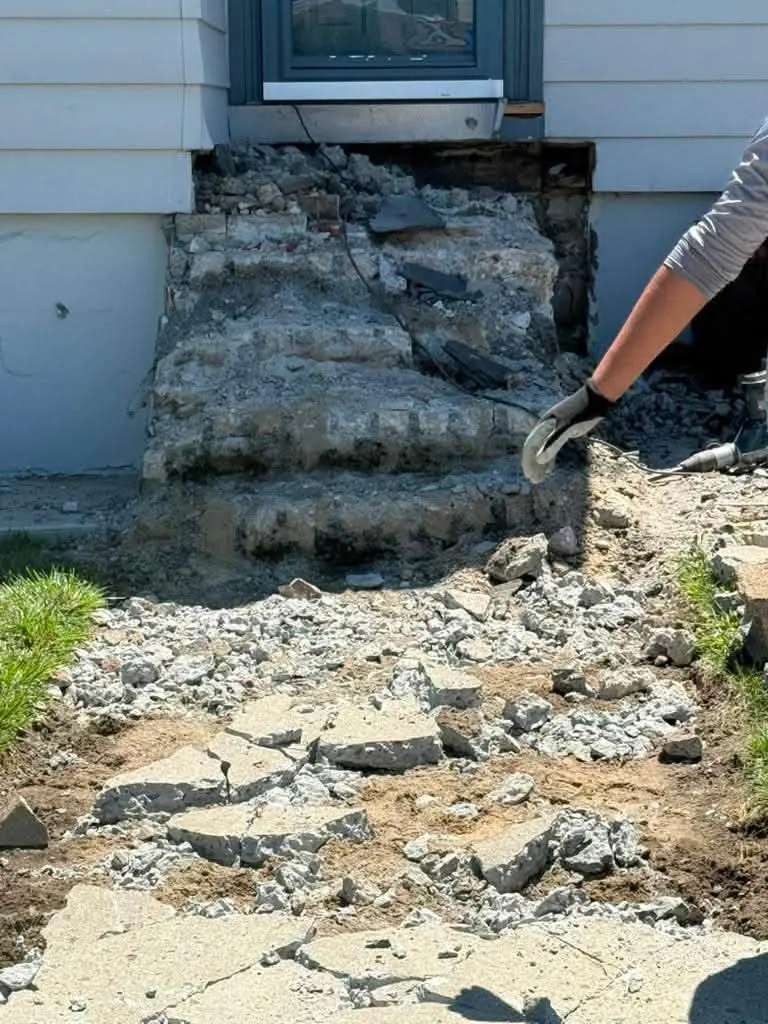
Most failed masonry in North Jersey did not fail at the surface. It failed underneath, where a thin or uncompacted base held water through a freeze and lifted the whole assembly. Cracked joints and settled slabs are the symptom.
We excavate to depth, compact in lifts, and build in the drainage the site needs — filter fabric, clean stone, weep outlets behind retaining walls. Then the visible work: cut stone, brick or block, laid to consistent joints and pitched away from the house.
That approach applies whether we are rebuilding a front stoop, pouring a concrete patio, terracing a sloped yard with a multi-tier wall, or repairing a sidewalk that has become a trip hazard.
What the work includes
- Poured concrete and natural stone patios and walkways
- Front steps, stoops and multi-level stone staircases
- Natural stone retaining and garden walls with proper drainage
- Sidewalk repair and replacement to municipal standards
- Stone veneer, brickwork, repointing and foundation repair
Why does masonry fail in New Jersey?
Masonry in New Jersey fails mainly because water gets into or under it and then freezes. A weak base, poor drainage, cracked joints and de-icing salt all feed that cycle. Surface cracks and settled slabs are symptoms; the cause is almost always below or behind the visible work.
The base
A slab, step or wall is only as stable as what it sits on. Topsoil, uncompacted fill or a thin layer of sand holds water and settles unevenly. When that water freezes it expands, lifts the work and leaves a void when it thaws.
Water
Water arrives from above (rain on open joints), from behind (soil holding groundwater against a wall) and from below (a high water table). Brick Industry Association guidance says the origin of a moisture problem has to be corrected along with the visible damage, or the symptoms return. Gutters that dump beside a stoop or a foundation are a common source, which is why we look at the gutter system on masonry estimates.
Freeze-thaw
Each freeze drives absorbed water into joints and pores and expands it. Mortar crumbles, brick faces spall and concrete scales.
De-icing salt
Iowa State University Extension notes that salt-based de-icers can corrode metal and concrete, and that calcium magnesium acetate is gentler on concrete, although it costs more. On new concrete steps and walks, shovel first and use sand for traction.
Which masonry service does your property need?
Match the problem to the service: crumbling or uneven steps need masonry steps, trip hazards along the street need a poured concrete sidewalk, a bare slope or soil that keeps washing out needs a natural stone wall, a leaning chimney needs masonry chimney work, and cracks or dampness at the footing point to foundation repair.
| What you are seeing | Service to look at | What decides the scope |
|---|---|---|
| Crumbling treads, loose rail posts, a stoop pulling away from the house | Masonry steps and stoops | Condition of the footing and whether the steps carry a roof or porch |
| A cracked, heaved or ponding path to the door | Poured concrete walkways | Base, pitch away from the house and joint layout |
| A sidewalk slab at the curb that has tilted or broken | Poured concrete sidewalks | Your town’s specification and any approval it requires |
| No usable outdoor space, or runoff pooling beside the house | Poured concrete patios | Slope, drainage and how the patio meets the foundation |
| A slope that is eroding, or a yard that needs levels | Natural stone walls | Wall height, what the wall holds back and drainage behind it |
| Stepped cracks, efflorescence or damp walls in the basement | Foundation repair | Whether the movement is active and where the water enters |
Brick and stone veneer, repointing and masonry chimneys fix the face of a building rather than the ground around it, and are covered below. Drainage and foundation problems come first, because anything built beside a wet foundation inherits the same water.
What does a masonry chimney need that other masonry does not?
A masonry chimney needs a sound crown, correct flashing, healthy mortar joints and a flue liner in good condition, because it is exposed to weather on all sides and to heat and combustion gases inside. Repointing, crown repair, rebuilding above the roofline and liner work are all handled under our chimney service pages.
A chimney is the most exposed masonry on a house, open to weather on every face. We keep the detail on the chimney pages so each topic lives in one place:
- Chimney repair: repointing, crown and cap repair, flashing and replacement of damaged brick.
- Chimney rebuilds: taking the stack down to sound masonry and rebuilding it when repair no longer makes sense.
- Chimney liner installation: relining a cracked or unlined flue for safe venting.
- The chimney services overview for caps, chase covers and cleaning.
Our post on the signs you need brick and chimney repair shows what each looks like from the ground.
How does repointing work, and why does mortar matching matter?
Repointing removes failed mortar from the joints to a uniform depth and replaces it with new mortar. The new mortar must be equal to or weaker than the original, because a stronger mix concentrates stress on the brick or stone and can make the face spall instead of the joint.
Mortar is meant to be softer than the units it holds, so that wear lands on the joint, not the brick or stone. Brick Industry Association guidance says the compressive strength of repointing mortar must be equal to or lower than that of the original, and warns that a stronger mortar increases stress at the brick and mortar interface and can lead to spalling of the brick face.
What proper repointing involves
- Cutting out deteriorated mortar to a uniform depth, at least twice the joint width, or until sound mortar is reached, without chipping the edges of the units.
- Packing the new mortar in thin layers and tooling the joint to match the original profile.
- Matching color and, on older work, the mix. Type N is common on modern work; softer types are used on older masonry.
The same rules apply to natural stone walls, foundation walls and the brick around your front steps. Hard, cement-rich patch over open joints is the most common mistake we are called to correct.
Brick and stone veneer: what is it and when is it the right choice?
Brick or stone veneer is a non-structural facing of real masonry or thin stone applied over a structural wall. It is used to dress up foundations, steps, columns and entries. Veneer lasts when water is managed behind it with flashing, weep openings and a gap or drainage layer.
Veneer does not hold the building up, so the details behind it decide whether it lasts. Flashing at the base and over openings, weep openings that let trapped water out, and ties that anchor the facing to the wall behind are what separate a veneer that ages well from one that bulges and stains.
Common uses include a stone-faced foundation wall or entry, facing around steps and stoops, and porch or driveway columns. When we repair existing veneer, the first job is finding why it failed: efflorescence, open joints and loose units usually trace to missing flashing or a leak above, sometimes from the roof. We fix that source first, whether it is roof repair or gutters, so the new masonry does not inherit the damage.
When do you need a permit for masonry work in New Jersey?
In New Jersey, masonry permits are issued by your municipal construction office under the Uniform Construction Code. A retaining wall with a total height of four feet or more needs a construction permit, as does a shorter wall that could affect a foundation. Patios, walkways and sidewalks are not among the work the code lists as exempt.
There is no county permit office. Each town runs its own construction code office, or hands the work to a regional office of the Department of Community Affairs (DCA) that enforces the State Uniform Construction Code for that town. Either way, the permit application goes to the municipal side first.
Under N.J.A.C. 5:23-2.14, a construction permit is required to build, alter or demolish a retaining wall with a total height of four feet or more, and also for a wall under four feet that has a negative impact on a foundation. Replacing a porch or stoop that does not support a roof or part of a building is minor work under N.J.A.C. 5:23-2.17A. Sidewalks add a separate layer: in many towns the owner is responsible for the sidewalk, but the town’s engineer or public works department sets the specification and may need to approve the work.
We check with your municipal office before we price. Rules for retaining walls are covered in more depth on the stone walls page, and sidewalk specifications on the sidewalk page. Our guide to poured concrete sidewalk replacement in New Jersey walks through what to ask your town.
How do you choose a masonry contractor in Bergen County?
Choose a masonry contractor who is registered as a New Jersey home improvement contractor, carries insurance, inspects the site before quoting, and puts the full scope in writing, including the base, drainage and permit work. A contractor who quotes only the visible surface is leaving out where most masonry fails.
A finished walk or wall looks the same on a compacted base or on loose fill, so ask about the part you cannot see:
- What is under the work, and how deep is the excavation?
- Where does the water go? On walls, what is behind the wall and how does it drain?
- Who pulls the permit, and does the contractor verify the town’s requirements before pricing?
NJ Gold Star Construction is registered as a New Jersey home improvement contractor (NJ HIC #13VH13359900), fully insured, and uses its own crew rather than subcontractors. Our checklist on how to choose contractors in New Jersey applies to masonry as well. To start, request a free written estimate.
What is the best time of year for masonry work in North Jersey?
Late spring through early fall is the easiest window for masonry in North Jersey, because mortar and concrete cure properly in mild, dry weather. Winter work is possible with cold-weather protection, and emergency repairs to dangerous steps or leaning chimneys do not wait for spring.
Fresh concrete or mortar that freezes before it has set can be damaged permanently, so cold-weather work needs protection such as blankets or heat, which adds time and complexity.
Plan on a rough seasonal calendar:
- Spring: inspect everything that went through the winter. Look for heaved slabs, loose steps, new cracks and joints that have opened. Book repointing and wall work now.
- Summer: ideal for poured concrete and new construction, with the caution that hot, windy days need attention to curing.
- Fall: good for repairs that need to be done before the first freeze, and for fixing drainage before the ground is wet and cold.
- Winter: make safe, hold repairs for spring and keep de-icers gentle on new concrete.
Concrete placed late in the season should not see de-icing chemicals in its first winter. If you have an urgent issue, such as an unsafe step or a chimney leaning, call or text (862) 271-1225 and we will make it safe first and schedule the permanent repair after.
Masonry services we provide
Poured concrete and natural stone patios built on a compacted stone base with proper pitch, edge restraint…
Front and side walkways in poured concrete, bluestone or brick, laid on a compacted base with consistent j…
Repair of cracked, spalling and water-damaged foundation walls — repointing, parging, crack repa…
Sidewalk repair and replacement to municipal standards — removing trip hazards, correcting pitch…
New and rebuilt front steps, stoops and multi-level stone staircases with consistent riser heigh…
Natural stone retaining and garden walls built on a compacted base with drainage behind them…

Masonry service areas
We provide masonry from our Totowa base across these towns. Each link opens that town’s page, with local permit and building notes.
Bergen County: Allendale · Bergenfield · Cliffside Park · Demarest · Elmwood Park · Emerson · Englewood · Fair Lawn · Fairview · Fort Lee · Franklin Lakes · Garfield · Glen Rock · Hackensack · Harrington Park · Hasbrouck Heights · Hillsdale · Lodi · Mahwah · Montvale · Old Tappan · Oradell · Palisades Park · Paramus · Park Ridge · Ramsey · Ridgefield Park · Ridgewood · Rochelle Park · Rutherford · Teaneck · Tenafly · Waldwick · Westwood · Woodcliff Lake · Wyckoff
Passaic County: Clifton · Haledon · Hawthorne · Little Falls · Paterson · Totowa · Wayne · West Milford
Essex County: Montclair · Nutley · Verona
Hudson County: Jersey City · Secaucus
Morris County: Morristown · Parsippany
Union County: Summit
Rockland County, NY: Suffern, NY
Not listed? Call (862) 271-1225 and ask whether we cover your address.
Where we work: from our Totowa base across North Jersey
Frequently asked questions
Why do my steps or walkways keep settling?
Almost always an inadequate base. Slabs and stones set on sand alone, or on fill that was never compacted, hold water and move with every freeze. Rebuilding on a compacted stone base with proper pitch solves it permanently.
Do you handle masonry, walkway, sidewalk, and deck repairs too?
Yes. Along with roofing and chimney work we build and repair steps, walkways, patios, sidewalks, retaining walls, stone veneer, foundations and decks — all designed with drainage and long-term stability in mind.
How long should masonry last if it is built correctly?
Well-built masonry can last for decades because brick, stone and concrete are durable materials. What shortens that life is water: a poor base, no drainage, open joints and de-icing salt. The service life of any specific job depends on site conditions, so we explain what will limit it in the written estimate.
Is it better to repair cracked masonry or replace it?
Repair makes sense when the base is still sound and the damage is limited, such as open joints or a few spalled units. Replacement is better when the base has settled, the slab has broken in several places, or units are failing across the whole face. We look under and behind the work before recommending either.
Can masonry steps be repaired without a full rebuild?
Often yes. Loose treads, open joints and small spalls can be reset and repointed. If the footing has moved, the steps are pulling away from the house, or concrete is crumbling through its thickness, a rebuild is safer. See our page on masonry steps for how we decide.
- N.J.A.C. 5:23-2.14 Construction permits, when required — Cornell Law School Legal Information Institute
- N.J.A.C. 5:23-2.17A Minor work — Cornell Law School Legal Information Institute
- Local (Regional) Code Enforcement Offices — New Jersey Department of Community Affairs
- Technical Note 46: Maintenance of Brick Masonry — Brick Industry Association
- Deicers: helpful or harmful? — Iowa State University Extension and Outreach
Updated September 2026 · Reviewed by Edgar Lopez Gonzalez, owner · NJ HIC #13VH13359900
Licensed & insured. 25+ years in North Jersey. We answer 24/7 for leaks and storm damage.
- Service area
- Bergen, Passaic, Essex, Hudson, Morris & Union County, NJ
- License
- NJ HIC #13VH13359900
- Estimates
- Free, written and itemized
- Emergency
- 24/7 response for active leaks and storm damage