
Walkways in Bergen County, NJ
Front and side walkways in poured concrete, bluestone or brick, laid on a compacted base with consistent joints and pitch that keeps water off the steps and away from the house.
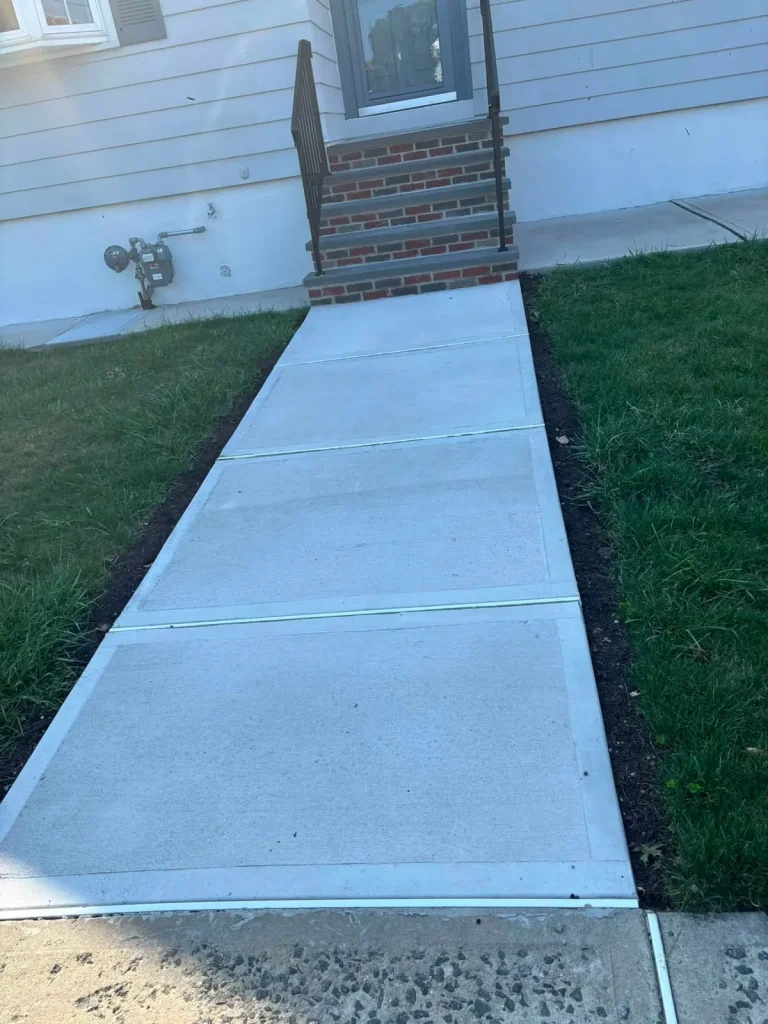
A walkway is the first thing anyone touches on your property, and the first place settlement shows. We build the base to patio standard even on a three-foot-wide path.
This is one part of the masonry work we do across Bergen and Passaic County. Every job is quoted in writing after a hands-on inspection, performed by our own crew rather than subcontractors, and backed by our satisfaction guarantee. We are licensed under NJ HIC #13VH13359900 and fully insured.
What the work includes
- Poured concrete, bluestone and brick walkways
- Curved and radius layouts with cut borders
- Step and landing integration at the entry
- Pitch and drainage away from the foundation
Which walkway material suits your entry: concrete, bluestone or brick?
Poured concrete suits long, straight front walks and driveway crossings. Bluestone suits formal entries and garden paths where color and texture matter. Brick, mortared over a concrete slab, matches older brick homes and steps. The right choice depends on your house, how much traffic the walk carries, and the winter salt it will see.
| Material | Strengths | Watch for |
|---|---|---|
| Poured concrete | Seamless, strong, quick to build; broom finish grips well | Cracks if the base is poor; scales under repeated chloride salt |
| Bluestone | Natural color, long life, suits steps and landings | Smooth faces get slick; joints need upkeep |
| Brick on a slab | Matches brick homes and stoops; repairable by unit | Mortar joints weather; needs the slab beneath to stay sound |
A walkway is also a visual extension of the house. A poured concrete walk with a crisp edge and a clean broom finish looks right in front of a vinyl-sided colonial. Bluestone treads and a bluestone walk look right with brick or stone veneer. We will often suggest a poured walk with a bluestone landing at the door, which gives you the strength of concrete and the finish where people actually stand.
Costs depend on length, width, access and finish, so we price each walk in a free written estimate.
How wide and how level should a walkway be?
A front walkway should be wide enough for two people or a person with groceries, which means at least three feet, and four feet for a main entry. The surface should pitch about a quarter inch per foot sideways to shed water, with level landings at doors and steps so nobody has to step up or down unexpectedly.
Layout is where a walkway succeeds or fails. We walk the path with you before forming it. A walk that follows the way people actually travel, from the driveway to the door, is used. A walk that fights the natural route gets a worn track across the lawn beside it.
Things we lay out before forming
- Width. Wider at the front door and at the driveway, narrower on a side path to the yard.
- Cross-slope. Enough to drain, not enough to feel tilted.
- Landings. Level at the door and at the top and bottom of any steps.
- Curves. Gentle radii form cleanly in concrete and cut cleanly in stone.
Where the walk meets steps, riser heights must match from top to bottom. The International Residential Code, as summarized for the 2018 edition, limits risers to 7-3/4 inches and allows only 3/8 inch of variation within a flight. We build to that on our masonry steps and stoops, and the walk is graded to meet the first step.
Base, joints and thickness: how a walkway avoids cracking
A poured concrete walkway should be at least four inches thick on a compacted stone base, with control joints cut a quarter of the slab depth and spaced so cracks form in the joints. A thicker slab with reinforcement is needed where the walk crosses a driveway.
New Jersey’s Residential Site Improvement Standards, which govern new subdivisions, require concrete sidewalks to be four inches thick, six inches at vehicle crossings, with welded wire fabric or an equivalent reinforcing at those crossings. Your private walkway is not bound by that rule, but it is a sensible benchmark and we follow it where a walk crosses a driveway.
What controls cracking
- Compacted base. Crushed stone compacted in lifts, so the slab is not sitting on loose fill from the original excavation.
- Joints. The Portland Cement Association notes contraction joints can be made with a hand groover or saw cut once the concrete is strong enough to prevent raveling.
- Isolation. A compressible joint where the walk meets a stoop, the foundation or a driveway apron, so each piece can move on its own.
- Curing. Keeping the concrete moist is what builds durability, the PCA says, and it matters most in the first days.
Concrete cracks happen. Our job is to put them where they do the least harm.
Slip resistance, salt and winter safety
Slip resistance on a walkway comes from the surface texture: a broom finish on concrete, a natural-cleft or thermal finish on bluestone, and a rough face on brick. Smooth or polished surfaces are risky when wet or icy. Chloride de-icers also damage concrete, so shovel and use sand where you can.
In a New Jersey winter a walkway is a safety feature before it is a design feature. A polished stone surface can look great in the showroom and be treacherous after freezing rain. Concrete with a broom finish gives the best everyday grip, and we choose stone finishes for traction first.
De-icing salt is the other half. Iowa State University Extension identifies chloride as the most problematic element in common de-icers because it corrodes metal and concrete, and names calcium magnesium acetate as less harmful to concrete. A walk that is shoveled early and sanded needs far less of either.
Drainage affects safety too. A walk that holds a puddle at the bottom of a slope becomes an ice sheet at night. We pitch the surface so water leaves it and keep downspouts from discharging onto it; see our gutter installation and repair for that side of the problem.
New concrete is most sensitive in its first winter, so keep salt off it as much as possible.
Planning for lighting, drainage and what lives beside the walk
The cheapest time to plan walkway lighting is before the slab is poured. We can set empty conduit sleeves under the path so landscape or step lighting can be added later without cutting the concrete, and we grade the walk so water runs away from the foundation and the stoop.
Sleeves are a few feet of PVC pipe set under the walk at a planned crossing. They cost very little to place and a great deal to retrofit. An electrician pulls wire later. We do not do the electrical work, so we leave the sleeve capped, and mark where each end comes out.
Drainage deserves the same planning. A walkway running along the house can steer water toward the wall if it is graded wrong, and a damp foundation is hard to separate from a walkway problem once it starts. If you already see dampness or cracking at the foundation, our foundation repair page explains what we look for.
A walk often ends at a patio or at the street, and we like to design them together. Our concrete and stone patios use the same base method, and if the path ends at a public sidewalk, our sidewalk repair and replacement covers the apron and town specifications. Natural stone edging or a low garden wall from our stone walls work can finish the border.
How a walkway project is built, from layout to cleanup
A walkway project with NJ Gold Star Construction follows the same five stages: on-site layout and estimate, excavation and base, forming or stone setting with joints, curing or pointing, and cleanup. Most walkways are finished in a few working days, depending on length and access.
We serve homeowners across Bergen and Passaic County, from Paramus to Totowa. To talk through a walkway, request a free estimate.
Layout and estimate
We stake the route, agree on width and landings, and write an itemized estimate.
Excavation and base
Soil is removed to depth and the stone base is compacted in lifts.
Forms, conduit and reinforcement
Forms are set to the pitch, sleeves placed, and reinforcement added where required.
Pour or set
Concrete is poured, finished and jointed, or stone and brick are set in mortar.
Cure and clean up
The work is protected while it cures and the site is left clean.
Related masonry services
Poured concrete and natural stone patios built on a compacted stone base with proper pitch, edge restraint…
Repair of cracked, spalling and water-damaged foundation walls — repointing, parging, crack repa…
Sidewalk repair and replacement to municipal standards — removing trip hazards, correcting pitch…
New and rebuilt front steps, stoops and multi-level stone staircases with consistent riser heigh…
Natural stone retaining and garden walls built on a compacted base with drainage behind them…
Walkways service areas
We provide walkways from our Totowa base across these towns. Each link opens that town’s page, with local permit and building notes.
Bergen County: Allendale · Bergenfield · Cliffside Park · Demarest · Elmwood Park · Emerson · Englewood · Fair Lawn · Fairview · Fort Lee · Franklin Lakes · Garfield · Glen Rock · Hackensack · Harrington Park · Hasbrouck Heights · Hillsdale · Lodi · Mahwah · Montvale · Old Tappan · Oradell · Palisades Park · Paramus · Park Ridge · Ramsey · Ridgefield Park · Ridgewood · Rochelle Park · Rutherford · Teaneck · Tenafly · Waldwick · Westwood · Woodcliff Lake · Wyckoff
Passaic County: Clifton · Haledon · Hawthorne · Little Falls · Paterson · Totowa · Wayne · West Milford
Essex County: Montclair · Nutley · Verona
Hudson County: Jersey City · Secaucus
Morris County: Morristown · Parsippany
Union County: Summit
Rockland County, NY: Suffern, NY
Not listed? Call (862) 271-1225 and ask whether we cover your address.
Where we work: from our Totowa base across North Jersey
Frequently asked questions
Can you match my existing stone?
In most cases yes — we source to match color and thickness, or reuse salvaged stone where the layout allows.
Do walkways need a permit?
Usually not, but municipal requirements vary. We tell you what your town requires before we start.
Can a walkway be replaced without tearing up my lawn and plantings?
Mostly yes. The crew works from the path itself, and we protect nearby plantings with boards and covers. Some lawn damage is unavoidable where forms and equipment pass, so we talk through access in the estimate and repair the edges of the path with soil and seed.
How long does a new concrete walkway take to cure?
You can usually walk on a new concrete walkway after a day or two, and heavier loads wait about a week. Concrete keeps gaining strength for weeks. Keep salt off the first winter and let the surface cure fully before sealing, which we time to the weather.
What lasts longer on a walkway, concrete or bluestone?
Both can last for decades when the base is sound and water drains. Concrete usually needs resealing and may crack along joints. Bluestone is dense and long-lived but needs its joints refilled or repointed. How it was installed matters more than which material you choose.
- N.J.A.C. 5:21-4.18 Sidewalks and bikeways construction standards — Cornell Legal Information Institute (New Jersey Administrative Code)
- Building Tips for Trouble-Free Slabs — Portland Cement Association
- Curing in Construction — Portland Cement Association
- Deicers: Helpful or Harmful? — Iowa State University Extension and Outreach
- Stairway, tread, riser and handrail details (IRC 2018 R311.7) — JAspector
Updated September 2026 · Reviewed by Edgar Lopez Gonzalez, owner · NJ HIC #13VH13359900
Licensed & insured. 25+ years in North Jersey. We answer 24/7 for leaks and storm damage.
- Service
- Walkways
- Category
- Masonry
- Service area
- Bergen & Passaic County and surrounding North Jersey
- License
- NJ HIC #13VH13359900